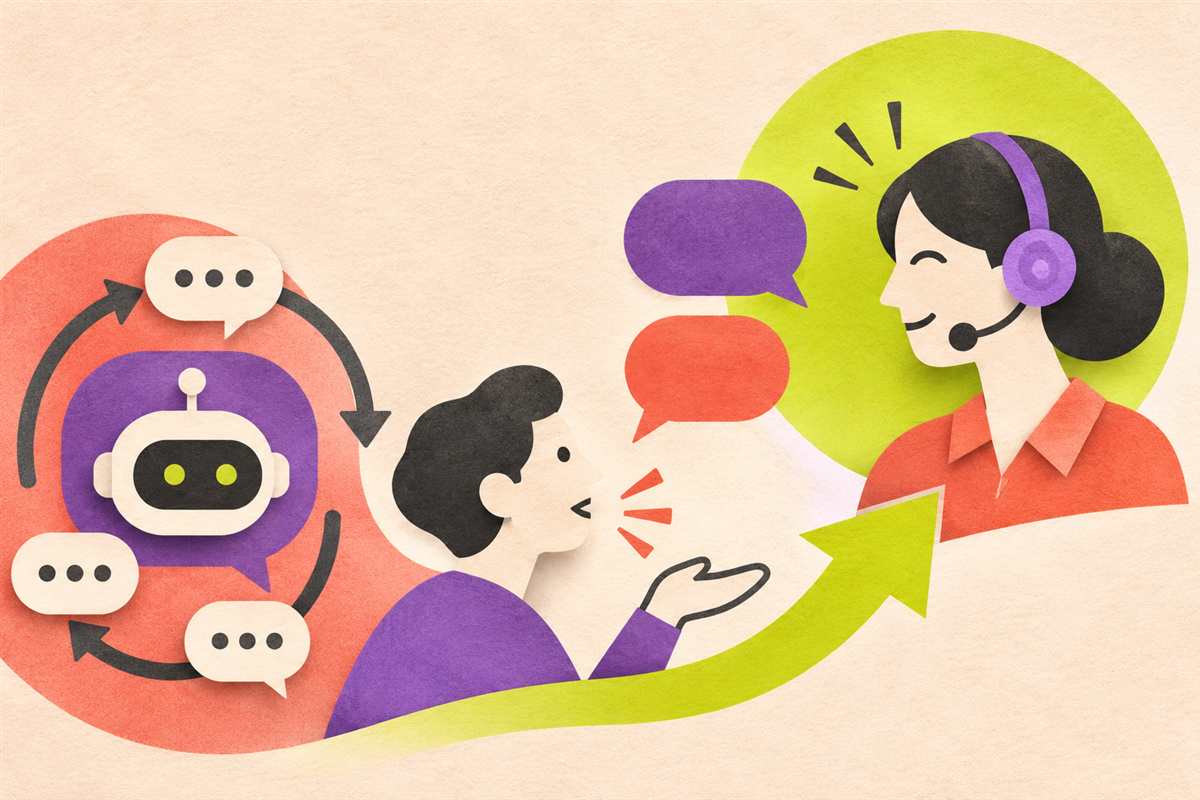
“Talk to a human” is becoming a design requirement for customer service, not a nostalgic preference. Across recent surveys, people say they will accept automated help when it is quick and useful. They also expect an obvious human handoff when the problem is unusual, sensitive or simply not being solved.
Human customer support is still the preferred safety net
Auth0’s Customer Identity Trends Report 2025 found that 70% of respondents preferred interacting with a human representative, compared with 16% who preferred an AI agent. The report says the strongest reason was simple: people believe a human understands their needs better.
The finding is not a rejection of every automated tool. It is a signal about where trust sits when the stakes rise. A customer may be happy to check an order status with a bot, then want a person as soon as the request involves a refund, a service failure or a decision that does not fit a menu.
People want speed, not a dead end
TCN’s 2025 survey of 2,000 consumers across the United States and the United Kingdom found that 50% still preferred speaking with a live agent over other contact methods. The same survey reported that service quality ranked above other factors when people chose between brands.
Twilio’s Inside the Conversational AI Revolution report adds an important detail: 78% of consumers said it was important to be able to switch from an AI agent to a human, but only 15% said they had experienced a seamless handoff. The gap is not about whether automation exists. It is about what happens when automation reaches its limit.
The best automated experience is one that knows when to stop being automated.
Why chatbot-only support loses trust
Reporting on a YouGov survey for Pega, ITPro found that 65% preferred human-led support, while only 2% wanted to interact exclusively with generative-AI chatbots. Half of respondents said they rarely or never got a successful outcome from AI-only interactions.
That helps explain why customers become frustrated. The issue is not that a bot sounds less warm than a person. It is that a loop, a dead end or a forced restart makes the customer do the work of the support system.
The practical model is hybrid, not human versus machine
The useful question for support leaders is not “Should we use AI?” It is “Where does automation help, and where should a person take over?” A workable model usually has four rules:
- Use automation for predictable requests such as status checks, routing and simple account questions.
- Make the human option visible before the customer becomes frustrated.
- Pass the conversation history and key details to the human agent so the customer does not repeat the story.
- Keep judgment-heavy decisions, exceptions and emotionally difficult conversations on a human path.
What this means for operators
Customer support teams still need speed, coverage and consistent processes. They also need people who can listen, make a sensible exception and explain what happens next. That is why a dedicated human layer can sit alongside automation instead of being replaced by it.
For companies reviewing their support model, the next step is practical: map the conversations that can be automated, mark the moments that require judgment and measure whether the handoff feels effortless. Work On Slot’s voice customer support service is built around that human layer, with clear workflows and escalation rules.
Sources
- Auth0 — Customer Identity Trends Report 2025
- TCN — 2025 Consumer Survey Results
- Twilio — Inside the Conversational AI Revolution
- ITPro — Your customers aren’t keen on that customer service chatbot
This is a Work On Slot curation of external reporting and survey findings. The linked publishers retain ownership of their original work.